A City Shaped by Nature’s Canvas
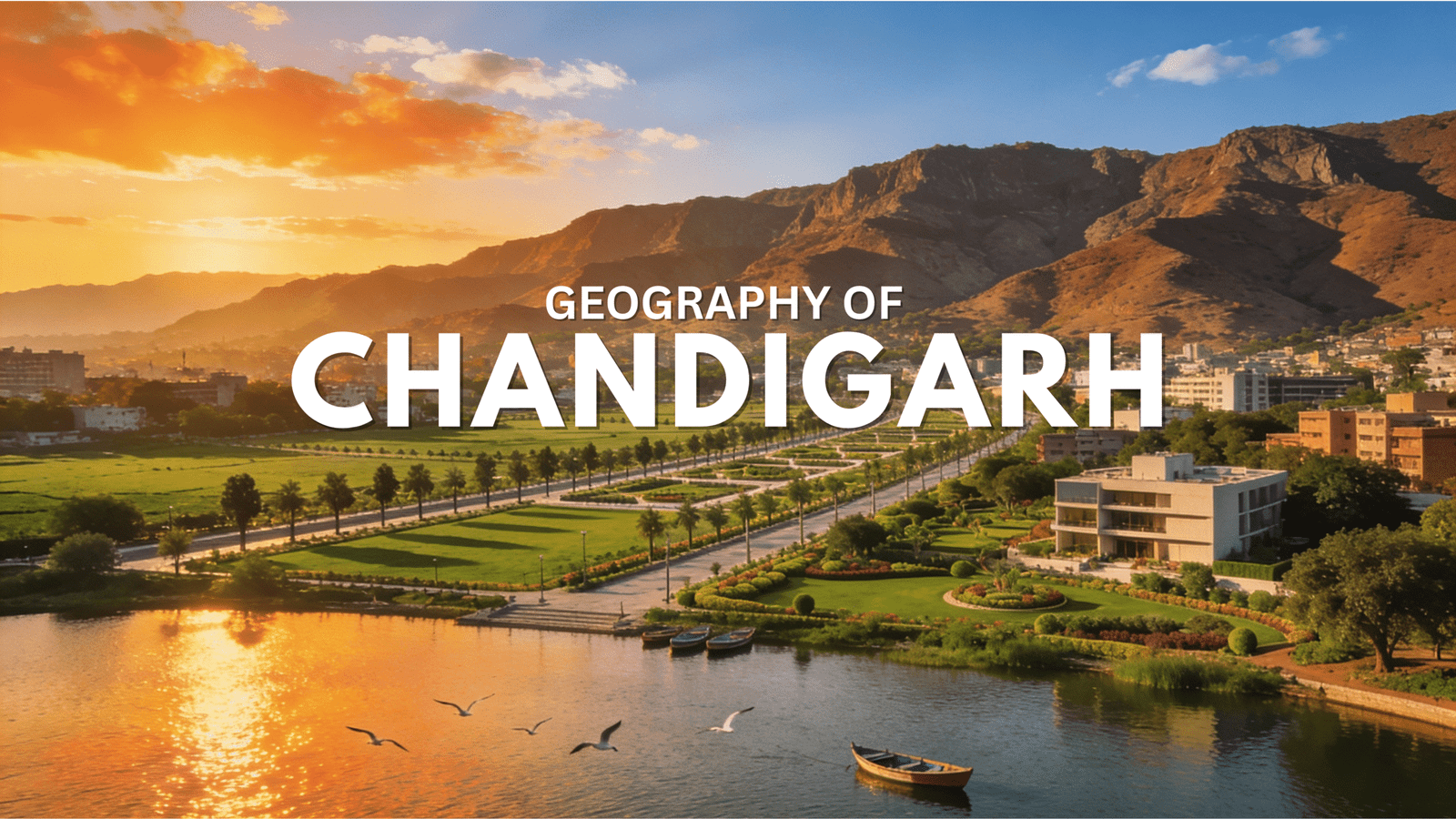
Ever wondered why Chandigarh feels different from other Indian cities? The answer lies in its remarkable geography. Nestled at the foothills of the majestic Shivalik Range, this City Beautiful isn’t just architecturally planned—it’s geographically blessed.
I still remember my first visit to Chandigarh. As I drove from the plains, the landscape gradually changed, and suddenly there they were—the gentle Shivalik hills embracing the city like a protective elder. That’s when I understood: Chandigarh’s geography tells a story that concrete alone never could.
The Physical Geography: Nature’s Blueprint
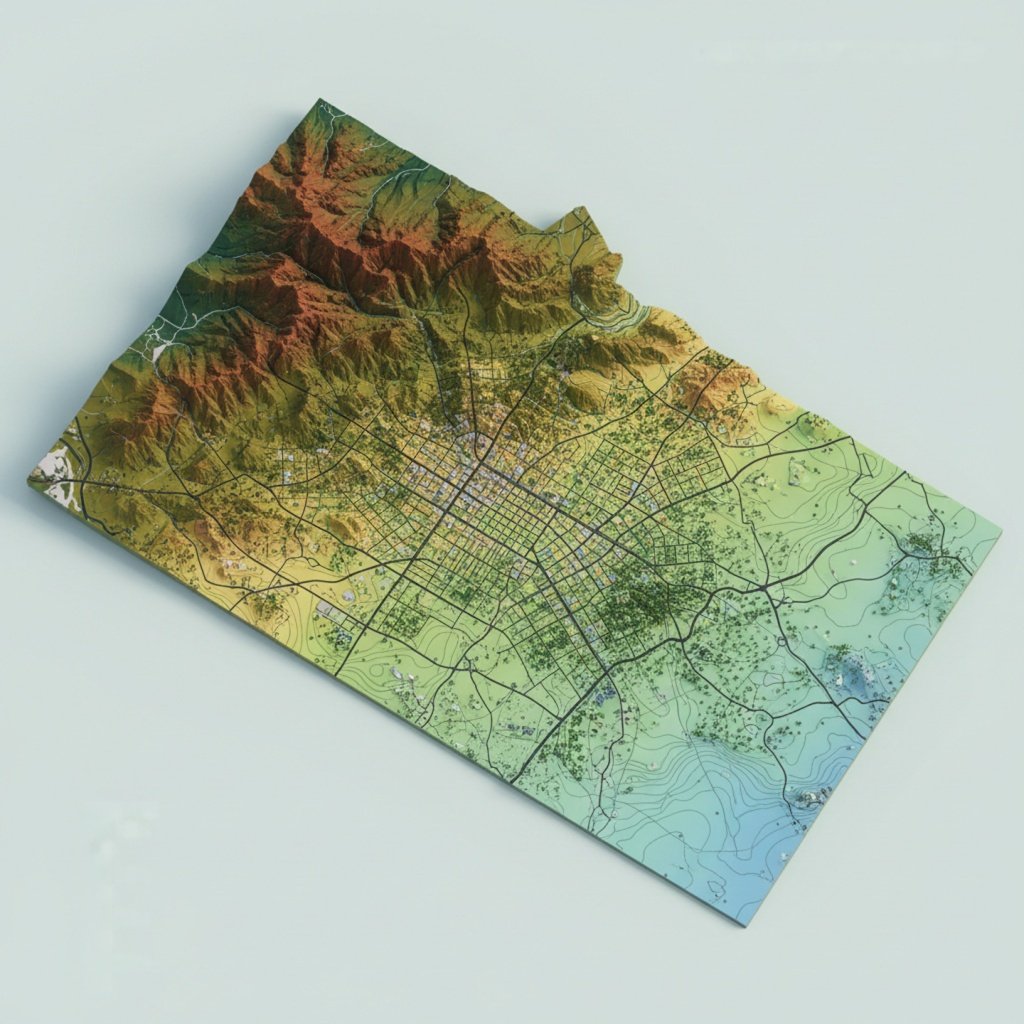
The physical Chandigarh geography begins at approximately 365 meters above sea level, where the Indo-Gangetic plains begin their ascent toward the Himalayas. The Chandigarh geography here is fascinating—imagine a gently tilted canvas sloping from northeast to southwest. This natural gradient isn’t just beautiful; it’s functional, allowing rainwater to flow naturally through the city’s sectors. Every aspect of Chandigarh geography has been carefully considered.
The Elevation Story: Where Plains Kiss Mountains
Standing at the geographical coordinates of 30.7333°N latitude and 76.7794°E longitude, Chandigarh geography occupies what geographers call a “piedmont zone”—that magical transition where flat plains meet rising hills. The elevation change across Chandigarh geography is subtle yet significant, dropping approximately 100 meters from the northernmost sectors to the southern boundaries.
I once met a civil engineer who worked on Chandigarh’s original planning team. He told me something fascinating: Le Corbusier spent weeks studying the natural geography before drawing a single line. He walked the land, observed how water flowed during rains, noted where the earth naturally rose and fell. The result? A city that doesn’t fight gravity—it embraces it.
Understanding the Slope: Geography in Action
The 2-3% gradient from northeast to southwest might sound minimal, but in Chandigarh geography terms, it’s gold. This slope means that every sector naturally drains toward the next. No water logging. No artificial pumping needed. Just Chandigarh geography doing what it does best—working efficiently.
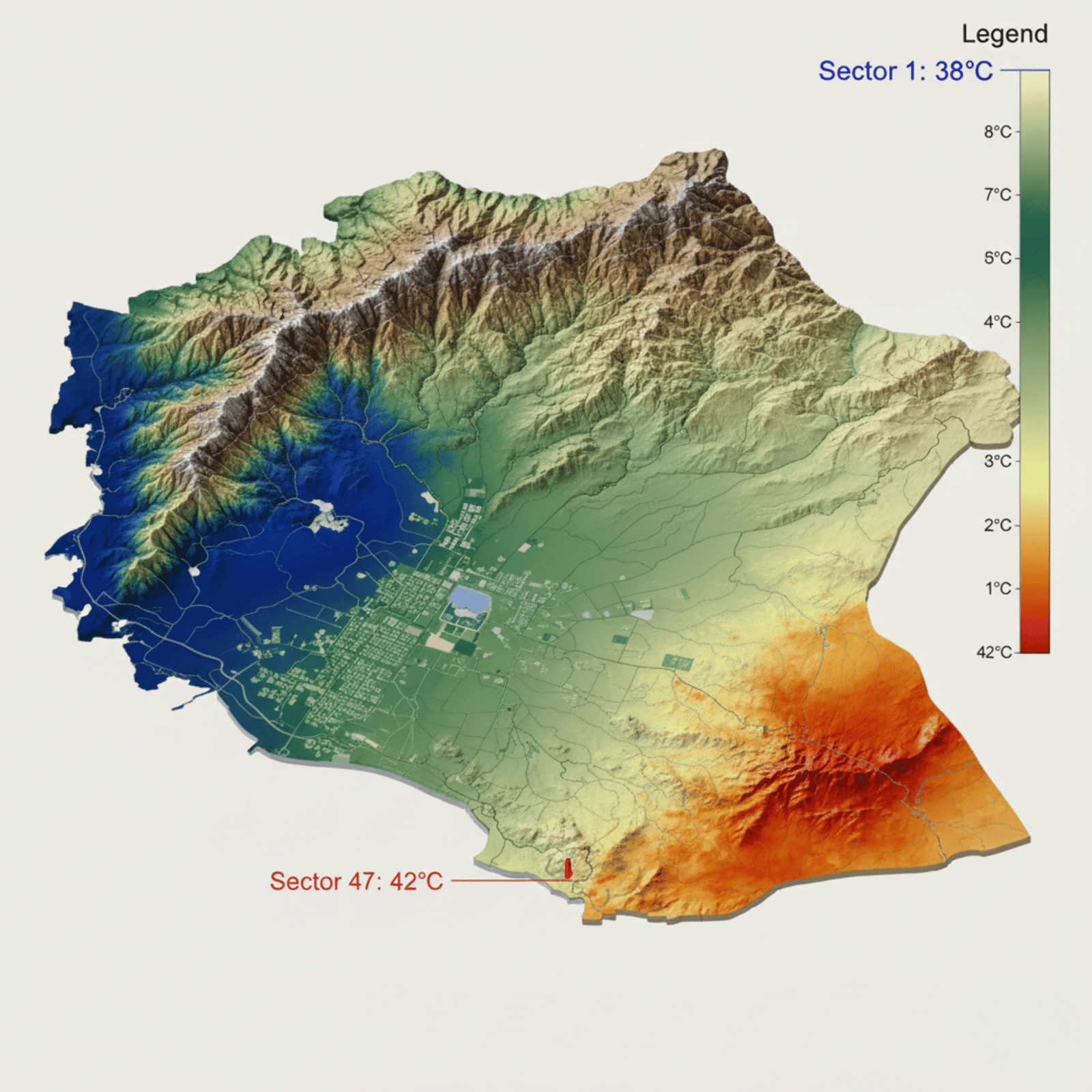
Local residents in Sector 1 (the northernmost) often joke that they live “at the top of Chandigarh.” Technically, they’re right. The Chandigarh geography literally places them at the highest point of the city, closest to the Shivalik base. Drive from Sector 1 to Sector 47, and you’re descending through Chandigarh geography, though your eyes might not catch it. Your car’s engine will, though—slightly less strain going south, a bit more effort returning north.
The Cho System: Ancient Geography Meets Modern City
What makes Chandigarh geography truly unique are the chos—seasonal streams that come alive during monsoons. These aren’t man-made drains; they’re ancient natural channels carved by water over centuries, integral to Chandigarh geography. Walk along one during the rainy season, and you’ll feel connected to something timeless through Chandigarh geography.
The major chos flowing through Chandigarh geography include the Patiala-ki-Rao, Sukhna Choe, and N-Choe. Each one follows the natural Chandigarh geography, cutting through sectors like liquid pathways. During dry months, these channels rest quietly in Chandigarh geography, often converted to green walkways. Come monsoon, and they transform into rushing streams, carrying rainwater from the hills to the plains.
I remember my first monsoon in Chandigarh. I stood near a cho in Sector 8, watching water surge past. An elderly uncle standing beside me smiled and said, “This water has been flowing this exact path for thousands of years. We just built a city around it.” That’s the essence of respecting geography.
The Shivalik Connection: More Than Just a Backdrop
The Shivalik Range, the outermost range of the Himalayas, forms the northern and eastern boundary of Chandigarh geography. These hills aren’t just scenic in Chandigarh geography—they’re geological storytellers. Composed of sedimentary rocks, they’re among the youngest Himalayan ranges, still actively forming and eroding, continuously shaping Chandigarh geography.
The Chandigarh geography of these foothills influences everything. They act as a watershed, collecting rainfall and feeding it to the chos in Chandigarh geography. They create microclimates—areas in the shadow of hills stay cooler in summer, while exposed sectors heat up faster. They even affect wind patterns in Chandigarh geography, creating natural air corridors that ventilate the city.
Soil Geography: The Foundation Beneath
Beneath Chandigarh’s roads and buildings lies fascinating soil geography. The region features primarily alluvial soil—fertile, well-drained, perfect for the city’s extensive green cover. This soil came from millennia of rivers depositing sediments from the Himalayas. It’s the same soil that makes Punjab’s agricultural belt so productive, and it’s foundational to Chandigarh geography.
But here’s what’s interesting about Chandigarh geography: the soil composition changes subtly as you move across sectors. Northern areas closer to the hills have slightly coarser, more gravelly soil with better drainage. Southern sectors feature finer alluvial deposits. This geographical variation in Chandigarh geography influenced where parks were planted, which tree species were chosen, even where water retention is better.
Geological Time in a Living City
The Chandigarh geography beneath tells a story spanning millions of years. The Shivalik sediments date back to the Tertiary period, while the alluvial plains are relatively recent—geologically speaking—forming over the last few thousand years. Walking through Chandigarh, you’re literally standing on the meeting point of different geological eras within Chandigarh geography.
Rock formations exposed in the northern sectors reveal layers of sandstone, clay, and conglomerate—evidence of ancient river systems that once flowed here. These aren’t just rocks in Chandigarh geography; they’re pages from Earth’s diary, and Chandigarh geography preserves them.
The Living Laboratory
What I find most remarkable is how Chandigarh geography serves as a living laboratory. Geography students from across India visit to study how urban planning can work with natural landforms in Chandigarh geography. The slope, the chos, the soil types, the proximity to hills—each element of Chandigarh geography offers lessons in sustainable development.
A geography professor once told me, “Most cities are built despite their geography. Chandigarh was built because of its geography.” And that understanding of Chandigarh geography makes all the difference.
Living with the Geography: A Daily Experience
The Chandigarh geography shapes everyday life in ways residents often take for granted. Morning joggers at Sukhna Lake watch the sun rise over the Shivalik foothills, painting the sky in shades of orange and pink. The cool breeze that sweeps down from the hills in the evening? That’s Chandigarh geography working its magic. Understanding how Chandigarh geography influences daily life reveals the city’s true character.
Morning Rituals Shaped by Geography
Wake up at 5:30 AM in any northern sector—say Sector 2 or 3—and you’ll experience what locals call the “hill effect” in Chandigarh geography. The air is noticeably fresher, cooler by 2-3 degrees compared to southern sectors. This isn’t perception; it’s Chandigarh geography. The proximity to the Shivalik foothills creates a natural air conditioning system as cooler air from higher elevations flows downward through Chandigarh geography.
I’ve met countless morning walkers who’ve structured their entire routine around this geographical phenomenon. Mrs. Sharma from Sector 9 told me she deliberately chose her apartment for its view and the morning breeze. “I don’t need an alarm,” she laughed. “The cool wind from the hills wakes me up naturally. It’s like the geography itself is saying ‘good morning!'”
Seasonal Geography: Living Through the Year
During summers, when temperatures soar to 40°C, people naturally gravitate toward the northern sectors—closer to the hills where it’s slightly cooler. In winter, when mercury dips to 4°C, those same hills block the harsh northern winds, creating microclimates across different sectors.
But there’s more to this seasonal geography than just temperature. In June and July, when the monsoon arrives, the entire city’s geography comes alive. The chos fill with rushing water, the smell of wet earth rises from the Shivalik base, and suddenly you understand why ancient settlers chose this exact location. The geography provides perfect drainage—no flooding despite heavy rains.
The Sector Geography: An Address That Tells a Story
Ask any Chandigarh resident where they live, and the sector number immediately tells you about their geographical experience. Sector 1-10? You’re living with hill views, cooler mornings, and that constant awareness of the Shivaliks watching over you. Sector 40-47? You’re in the southern geography, flatter land, more open skies, warmer evenings.
This geographical division has created distinct microcommunities. Northern sector residents are often avid trekkers—the hills are literally in their backyard. Southern sector folks? They’ve mastered the art of dealing with warmer geography, planting more shade trees, designing homes with better ventilation.
Traffic and Geography: The Commuter’s Reality
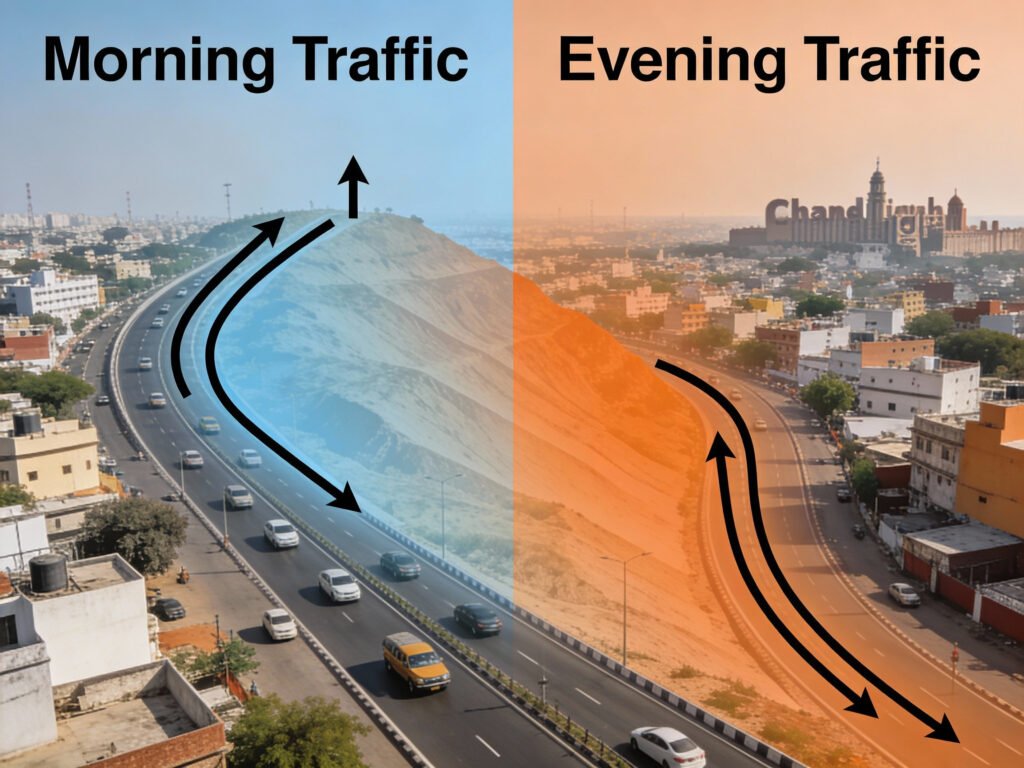
Here’s something fascinating that only daily commuters notice: traffic patterns follow geography. Morning rush hour sees heavy traffic moving northeast—people heading toward government offices and institutions clustered near the Capitol Complex, which sits at higher elevation. Evening reverses the flow as everyone descends back southward.
Rickshaw pullers and cab drivers have an intimate knowledge of this geography. “Going to Sector 1? That’s an uphill climb, extra charges,” they’ll tell you matter-of-factly. They’re not being unreasonable—they’re acknowledging geographical reality. Their vehicles literally work harder against gravity going north.
Water Geography in Daily Life
Every home in Chandigarh receives water based on geographical positioning. Northern sectors, being at higher elevation, needed different water pressure systems than southern sectors. The city’s water supply geography is a marvel of engineering that works with, not against, natural elevation.
Older residents remember the early days when this geographical water management was being perfected. “Sometimes water would be too strong in lower sectors, too weak in higher ones,” recalls Mr. Kapoor, who’s lived in Sector 7 since 1965. “Now it’s balanced perfectly. The geography dictated the solution—elevated tanks at strategic points matching the land’s natural levels.”
Garden Geography: Where Green Meets Gradient
The famous Rock Garden isn’t randomly placed—its location leverages natural geography. Built in a depression formed by the Sukhna Choe, it uses the natural amphitheater created by geographical erosion. Walk through it, and you’re literally descending through layers of geography that took thousands of years to form.
Similarly, the Rose Garden in Sector 16 sprawls across gently undulating geography, creating natural pockets for different rose varieties based on sunlight exposure and drainage. Gardeners here don’t just know botany—they know geography. They’ll tell you which slopes retain morning dew longer, which sections drain faster after rain, where frost settles first in winter.
Cycling Culture and Topography
Chandigarh’s cycling community has an unspoken understanding of the city’s geography. There are “easy routes” (generally south-to-north, working with gravity) and “training routes” (north-to-south returns that build endurance). Weekend cycling groups plan routes that showcase geographical variety—flat sectors for speed, sloping sectors for stamina, areas near chos for scenic beauty.
Young cyclist Arjun from Sector 34 maintains a detailed map of what he calls “geographical challenges”—specific routes that test your understanding of Chandigarh’s topography. “People think Chandigarh is flat,” he says. “Cyclists know better. Every sector has its own geographical personality.”
Real Estate and Geography
Property prices in Chandigarh correlate strongly with geography. Northern sectors command premiums not just for prestige but for tangible geographical benefits—hill views, cooler climate, natural air quality. Southern sectors offer their own geographical advantages—easier accessibility, flatter land for construction, proximity to the airport.
Real estate agents here are amateur geographers by necessity. They’ll explain how a particular plot’s elevation affects basement construction, how proximity to a cho influences monsoon drainage, how the Shivalik-facing aspect impacts sunlight hours. Geography isn’t just location—it’s value.
Climate Geography: Four Seasons, One City
Chandigarh’s geography blesses it with distinct seasons. The subtropical climate means you experience the full Indian weather palette. Monsoons bring about 1100mm of rainfall, transforming the city into a lush paradise. The chos swell with water, and suddenly, Chandigarh’s geography reveals its water management genius—all planned by Le Corbusier with nature’s contours in mind.
I’ve spoken with longtime residents who say autumn here is magical. The geography creates perfect conditions—not too hot, not too cold—just right for outdoor life.
Summer Geography: The Heat and the Hills
May and June test Chandigarh’s geography. Temperatures regularly touch 44-45°C, and the sun beats down mercilessly on the concrete and asphalt. But here’s where geographical positioning becomes crucial for survival. The Shivalik hills create afternoon shadows that stretch across northern sectors by 4 PM, providing relief hours before sunset officially arrives.
The local microclimate geography means that Sector 1 can be 3-4 degrees cooler than Sector 47 at the same time. It’s not imagination—it’s altitude, wind patterns, and the hill’s moderating influence. Smart residents know this. Summer weddings in farmhouses? They’re almost always booked in northern locations where geography offers natural cooling.
Monsoon Geography: When the City Transforms
June marks the arrival of the southwest monsoon, and Chandigarh’s geography truly shines. The 1100mm average annual rainfall doesn’t fall uniformly—the Shivalik foothills receive more precipitation than southern sectors, sometimes 20-30% more. This geographical variation in rainfall has shaped everything from agricultural patterns in surrounding areas to which sectors have lusher vegetation.
During monsoons, the cho system becomes Chandigarh’s lifeline. I’ve stood at the Sukhna Choe during peak rainfall, watching water rush with tremendous force. A hydrologist friend explained: “This cho drains an entire catchment area of about 42 square kilometers from the Shivaliks. Without this natural geographical drainage, Chandigarh would flood regularly.”
The geography creates a natural symphony during rains. Water flows from higher northern sectors through lower southern ones, eventually feeding into larger drainage systems. Stand anywhere in the city during a downpour, and you can almost feel the geography working—invisible gradients pulling water where it needs to go.
Autumn Geography: The Golden Season
October through November represents Chandigarh’s geographical sweet spot. The monsoons have recharged groundwater tables, the heat has dissipated, and the Shivalik foothills turn various shades of green and gold. The geography moderates temperatures perfectly—daytime around 25-28°C, nights dropping to comfortable 15-18°C.
This is when Chandigarh’s geographical design truly makes sense. The boulevards, aligned with the natural slope and wind patterns, become natural air corridors. The cool air from the hills flows smoothly through sectors, and the city breathes effortlessly. Residents flood outdoor spaces—the geography itself invites you outside.
Bird watchers know autumn geography intimately. The Sukhna Lake’s geographical position along migratory routes brings species from Siberia and Central Asia. The wetland geography created by the lake and surrounding marshes provides perfect habitat. Over 150 bird species have been recorded, all thanks to this specific geographical setup.
Winter Geography: Fog, Frost, and Microclimates
December through February brings dramatic geographical variations in temperature. Minimum temperatures can drop to 2-4°C, but it’s the fog that really defines winter geography here. The moisture from the Shivalik streams, combined with cold air settling in low-lying areas, creates dense fog that can reduce visibility to less than 50 meters.
The geographical pattern of fog is predictable: it forms first in southern sectors where elevation is lower and cold air accumulates. Northern sectors, being at higher elevation with the hills providing some thermal mass, often remain clearer. Drive from Sector 40 to Sector 1 on a foggy morning, and you literally emerge from clouds into sunlight.
Winter frost follows geography too. Areas near the chos, where moisture accumulates, see heavier frost. Gardens in these microsections require different plant species. Local gardeners have learned this geographical lesson over decades—what thrives in Sector 10 might struggle in Sector 35 despite being the same city.
Geography and Climate Change: An Evolving Story
Recent years have shown how changing climate patterns interact with Chandigarh’s geography. The 2023 monsoon brought record rainfall—1,600mm compared to the usual 1,100mm. The geographical drainage system, designed for specific volumes, was tested. Some chos overflowed, revealing that even brilliant geographical planning has limits when climate patterns shift.
Temperature records tell a geographical story too. Maximum temperatures have risen approximately 1.5°C over the past three decades. The urban heat island effect combines with natural geography—concrete-heavy southern sectors heat up faster than greener northern areas, creating temperature differentials of up to 5-6°C within the same city.
Seasonal Migration Within the City
Here’s a quirky geographical phenomenon: seasonal migration within Chandigarh itself. Families with multiple properties often shift between them based on seasons. Northern sectors in summer, southern sectors in winter—it’s like internal climate migration, all within 114 square kilometers. This isn’t just wealthy people’s indulgence; it’s practical adaptation to geographical microclimate variations.
Rental markets reflect this too. Agents report higher demand for northern sector properties during summer months, southern properties during winter. The geography literally drives economics.
Strategic Geography: More Than Just Location
Look at a map, and you’ll understand why Chandigarh geography made it the perfect choice for a capital. Positioned strategically in northern India, Chandigarh geography serves as the administrative heart for both Punjab and Haryana. The Chandigarh geography places it at a crossroads—literally and figuratively—between the fertile plains and the mountainous north.
For someone traveling from Delhi to Himachal Pradesh, Chandigarh is that transition point where you first feel the mountains calling. The Chandigarh geography here whispers, “The plains are behind you; adventure awaits ahead.” This strategic positioning in Chandigarh geography has made it a crucial hub for northern India.
Green Geography: A Garden City by Design
Here’s what sets Chandigarh apart: its geography isn’t fighting the urban landscape—it’s part of it. With over 8 square kilometers of forest cover, the city breathes. The famous Sukhna Lake, cradled against the Shivalik foothills, isn’t just a tourist spot; it’s where geography and human vision created something extraordinary.
Walk through Leisure Valley, and you’re following natural drainage patterns transformed into linear parks. That’s the beauty of respecting geography—work with it, not against it.
The 7V Geography: Nature’s Network
Chandigarh’s green geography is organized around the “7Vs”—seven interconnected valleys following natural drainage lines. This isn’t arbitrary urban planning; it’s geography dictating design. Each valley follows a cho or natural depression, creating a continuous green corridor spanning over 8 kilometers from north to south.
Walking the entire Leisure Valley system is like tracing Chandigarh’s geographical spine. You start at higher elevation near Sector 1, and gradually descend through sectors, following ancient water paths now beautified but still following their original geographical course. The native vegetation along these valleys—jamun, neem, sheesham—was chosen because the geography’s soil and moisture levels suit them perfectly.
Sukhna Lake: A Geographical Marvel
Created in 1958 by damming the Sukhna Choe, this 3-square-kilometer lake is pure geographical genius. Its location at the Shivalik foothills wasn’t random—it was chosen to capture runoff from a 42-square-kilometer catchment area. The lake’s geography serves multiple purposes: flood control, groundwater recharge, microclimate moderation, and recreation.
But here’s what most visitors don’t know: Sukhna Lake is slowly dying, geographically speaking. Siltation from the Shivalik hills has reduced its depth from 10-12 feet originally to barely 3-4 feet in some areas. The geography that created it is also filling it in—erosion from deforested hills bringing sediment downstream. Despite regular desilting, the lake loses about 2% of its volume annually to geographical processes.
Standing at the lake during sunrise, you’re witnessing a geographical ecosystem in action. The cool water surface creates temperature differentials that generate gentle breezes. These air movements carry moisture and coolness into nearby sectors—a natural air conditioning system powered by geography and physics.
Forest Geography: Islands of Wilderness
Scattered across Chandigarh are forest patches that represent preserved original geography. The Sukhna Wildlife Sanctuary, spanning 2,600 hectares (mostly in the Shivalik foothills), is where you see what this geography looked like before urbanization. Sal forests, scrubland, and grassland ecosystems follow elevation and soil gradients.
Trek through this sanctuary, and you’re climbing through different geographical life zones. Lower elevations feature mixed deciduous forests where soil is deeper. Higher slopes show scrub vegetation adapted to rocky, shallow soil geography. Each plant community reflects the micro-geography beneath it—water availability, soil depth, sun exposure, and slope angle.
Wildlife here follows geography too. Sambhar deer prefer gentler slopes with grassland geography. Himalayan porcupines inhabit rocky outcrops where the geography provides natural shelters. The geography literally structures the ecosystem.
Urban Forest Geography: The Sector Parks
Each sector’s park isn’t just landscaping—it’s carefully designed around micro-geography. Sector 10’s famous Rose Garden covers 30 acres of gently undulating land. The geographical depressions collect moisture, perfect for water-loving rose varieties. The raised areas with better drainage suit Mediterranean species.
Master gardeners at these parks are practical geographers. They’ll show you how a 2-foot difference in elevation determines whether a plant thrives or struggles. They understand that geography creates microclimates within single parks—frost pockets in low areas, sun traps on south-facing slopes, wind shelters behind earth mounds.
Street Tree Geography: The Boulevard Canopy
Chandigarh’s 35,000+ trees lining its boulevards follow geographical logic. Northern sectors with cooler geography feature more Eucalyptus and Pine—species that tolerate mild cold. Southern sectors, warmer and drier, have more Neem and Jamun trees adapted to heat stress.
The tree planting follows geographical contours too. Slopes are planted with deeper-rooted species to prevent erosion. Areas near chos feature willows and other moisture-loving trees. The geography dictates species selection, though most residents just enjoy the shade without realizing the geographical science behind it.
Green Cover and Climate Geography
Chandigarh’s 35-40% green cover isn’t just aesthetics—it’s geographical climate control. Studies show that areas with dense tree cover are 3-5°C cooler than open spaces. This green geography creates what meteorologists call “comfort islands”—geographical pockets where temperature, humidity, and air movement combine optimally for human comfort.
The geographical distribution of this green cover is strategic. Northern sectors, already cooler, have about 30% coverage. Southern sectors, naturally warmer, were planned with 40-45% green cover to compensate. It’s geographical problem-solving through landscape architecture.
Water Body Geography: More Than Just Aesthetics
Beyond Sukhna, Chandigarh has numerous smaller water bodies—each with geographical purpose. The N-Choe wetland, the Leisure Valley ponds, sector lake networks—these aren’t decorative. They’re part of a geographical water management system that recharges groundwater, moderates local climate, and provides wildlife habitat.
Each water body’s geography tells a story. Deeper lakes in higher sectors were designed to trap sediment from hill runoff. Shallow ponds in lower sectors spread water over larger areas for maximum groundwater percolation. The geography of water storage matches the geography of water flow.
The Green Belt Strategy: Protecting Geography
Chandigarh’s peripheral green belt—over 3,000 hectares—isn’t just a boundary. It’s geographical protection. These forests stabilize the Shivalik foothills, prevent erosion, maintain the cho watersheds, and act as the city’s lungs. This green geography is what keeps Chandigarh’s air quality relatively good compared to other North Indian cities.
But this geography is under threat. Encroachment, urbanization pressure, and forest fires are changing the landscape. What took thousands of years of geographical evolution to create can be destroyed in decades of neglect.
The Living Geography
What I love most about Chandigarh’s geography is how tangible it feels. You’re not reading about it in textbooks; you’re living it. The slopes influence where water flows, where sectors are positioned, how gardens are designed. The hills aren’t just scenery—they’re protectors, climate moderators, and daily companions.
Local cyclists know every incline and slope. Runners understand which sectors offer shaded routes thanks to geographical positioning. Even the sector numbers increase as you move away from the hills—a constant geographic reminder of where you are.
Geography Shaping Identity
The geography of Chandigarh isn’t just about physical features; it’s shaped the city’s identity. People here have a different relationship with nature because nature is visible, accessible, and integrated. Unlike cities where geography has been bulldozed into submission, Chandigarh wears its geographical heritage with pride.
When locals give directions, they don’t just mention sector numbers—they reference the hills, the lake, the natural landmarks. “Towards the hills” or “down from the lake” are navigation tools rooted in geographical awareness.
Conclusion: Geography as Destiny
Chandigarh proves that Chandigarh geography isn’t just about coordinates on a map. It’s about how land shapes life, how slopes influence design, how nature and city can coexist. The Chandigarh geography here isn’t background—it’s the main character in this urban story.
Next time you visit Chandigarh, don’t just see the buildings and boulevards. Feel the subtle slope beneath your feet, notice how the hills frame every northern view, observe how water flows naturally through the city. That’s Chandigarh geography—not just existing, but living and breathing with every resident. Understanding Chandigarh geography means understanding the soul of this remarkable city.
In a world of concrete jungles, Chandigarh geography reminds us that the best cities are those that dance with nature, not against it. The story of Chandigarh geography is ultimately a story of harmony between human ambition and natural landscape, a lesson in respecting Chandigarh geography while building for the future.